

The Together Spectrum.
A new way for committed couples to talk about what they want, with whom, and how much of it they get to share, together.

There is a question I have been asked, in different rooms, by very different people, for almost two decades.
It comes from married women in their fifties. From committed couples in their forties. From a friend on the second glass of wine at a Friday kitchen counter. The question takes many forms. Underneath, it is always the same one. Direct. Specific. Embodied. Asked, almost always, between two people who love each other.
The question is some version of this.
Is it okay that we want to do this together?
A wife who has been quietly wondering for years what it would feel like to make out with another woman. A husband who has been fantasizing about watching his wife with another man. A couple who has been talking, late at night, in the dark, about what their first threesome might actually feel like. A couple who has been wondering what a slow careful weekend with another couple they trust might look like. A couple who wants to share photos and videos with another couple, just for them. A husband and wife who have noticed, recently, that the part of their fantasy life that turns them on most is the part they finally said out loud to each other.
These are real fantasies. They are not exotic. They are not rare. They are the most common conversations happening at midlife kitchen counters in this country right now, in the kitchens that are safe enough.
Some couples get there. Most do not. The conversation feels too dangerous. They were taught that wanting more is the same as not loving each other. They are afraid of how the other will react. There is a moral ethic instilled in them since adolescence, often through some version of religious purity culture, that has told them in a thousand quiet ways that desire itself is the disloyalty.
I have a name for the place this conversation is trying to land. I have started calling it the Together Spectrum.
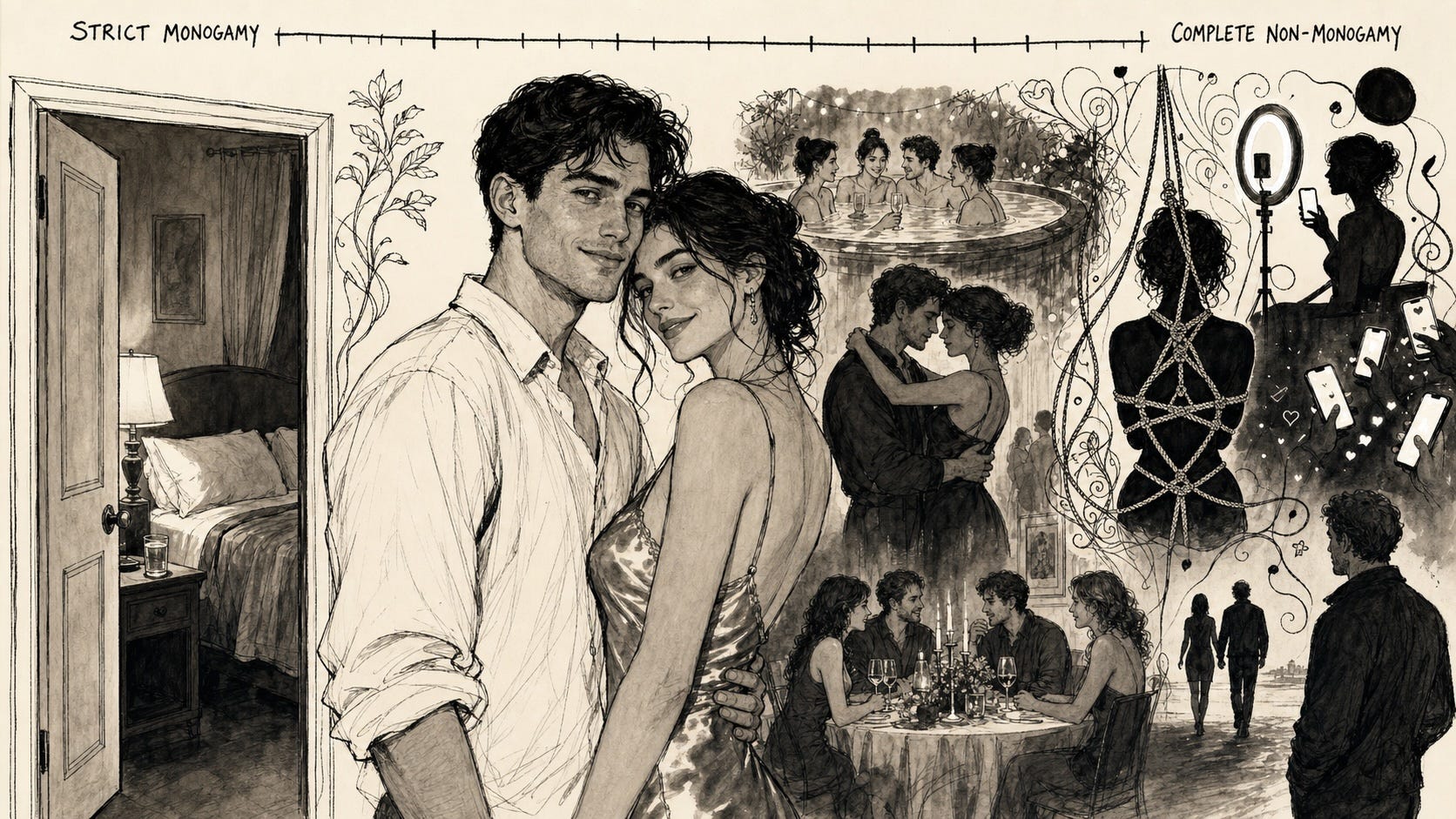
The Together Spectrum is a way for committed couples to talk about what they actually want, with whom, and how much of it they get to share, together.
It is not about who you sleep with. It is about how wide your together is allowed to be.
A note before we go further. Throughout this letter I will use the words committed couple. By that I mean any two people who have chosen each other for the long arc. Married. Cohabiting. Partnered. Queer. Straight. The Spectrum is for all of you.
I want to spend many letters on here building out the theory. Refining it. Polishing it. But today I simply want to put it on the table.
Why The Old Scales Will Not Hold This Conversation
As a former sex therapist and professor of human sexuality, I have watched grown couples rehearse some version of is it okay that we want this together for half a lifetime before they finally felt safe enough to have it out loud with each other. Some couples I know will never have it. Not because they do not want to. Because the fear, or the morals, or the imagined reaction of the partner they love will not let them.
One of the reasons it takes that long is that they have no scale to put themselves on. They have inherited two, and neither one was built for what they are actually trying to ask.
The first is Alfred Kinsey’s scale from 1948. Zero is one hundred percent straight. Six is one hundred percent gay. The quiet revelation, beneath the controversy, was that almost no one actually sits at zero or six. Most adults, especially most women, sit somewhere in the middle. Seventy-five years later, the data has only confirmed it.
The second is Fritz Klein’s grid, from 1978. Klein expanded Kinsey to include more dimensions of orientation. The question he was still answering was the same one. Who you find attractive.
That is not the question I keep getting asked.
The question I keep getting asked is structural. It is about the couple, not the orientation. It is about how much of the actual fantasy life of two people in love gets to be shared out loud, with each other, and acted on together, without either of them feeling like a traitor.
The Together Spectrum overlays on top of Kinsey. It does not replace it. A couple can be at one place on Kinsey and another on Together. Those are two different conversations. This one is about the couple.
The Poles
At one pole of the Together Spectrum is the strictest closed pact. One person. One bed. One door. Closed for life. No fantasy spoken out loud. No flirtation at the dinner party. No second look at the friend across the lake. No question of another body, ever, in the room.
That is the model most American adults were handed in the last century. It gets forgotten, but this is not how most cultures have lived across most of human history. The historian Stephanie Coontz, in Marriage, a History, traces how recent the strict version actually is. Romantic love marriage is a nineteenth century innovation. Strict sexual monogamy as the moral standard, rather than the contractual one, took hold in the Victorian era. Religious purity movements in the twentieth century, including the evangelical purity culture of the 1990s I came of age inside, reinforced it. For the last hundred and fifty years, this one shape has been treated as the only honorable one. It is not. It is a recent shape. Your great-great-grandparents would not have recognized it as the only valid one.
At the other pole is the fully open pact. Multiple partners. No exclusivity. Extreme kink as the baseline. Each partner out alone, on their own time, in their own rooms, dating other people without the other beside them. For a small number of couples, that shape works. For most couples, it does not.
Most of the couples I have ever sat with at midlife do not want to date apart. They want to do this with each other or not at all. The togetherness is not a constraint on the thrill. The togetherness is the thrill. That is the part the culture keeps missing.
Almost everyone lives in the middle.
The Middle
Later I am going to spend a whole letter on the middle. For now, I want to take the fear out of the word.
The middle is not the scary place. The middle is the most common place. The middle is where most of the couples I have ever counseled or sat with on my front porch with Mrs O, already quietly live, whether they have admitted it to each other or not.
Let me show you what the middle actually looks like.
The middle is the hot tub on a Friday night with your two closest friends. Second glass of wine in. The woman on the other side of the tub finally looks at the woman next to her. She says she has been wanting to kiss her for years. They start kissing. Both partners watch. Nothing about it is weird.
The middle is two or three couples who have been close friends for fifteen years. After the kids are in bed, in the kitchen, someone giggles that they could probably swap and it would not even be strange. So they play spin the bottle. The way they did at fourteen. Except now they are grown. And the spin lands where it lands. And nothing breaks.
The middle is the couple at midlife who has been talking, late at night, for months, about a threesome. They want a third. They want someone safe. They hop on an app, looking for one, thinking that is the best way to find it. They sit on the couch together. Scrolling. Laughing at the bad profiles. Slowly getting clearer about what they actually want.
The middle is the couple that has been quietly attracted to another couple in town for two years. They finally write a careful text. Would the four of us want to have a real dinner. Not the regular kind. The kind where everyone at the table knows what they are at the table for.
The middle is the wife who finally tells her husband she has been thinking about her closest friend for years. The husband exhales softly. He tells her he has known. He has been thinking about it too.
The middle is the slow careful long weekend with a couple you have known for ten years that ends in eggs and laughter and a closer marriage than either of you walked in with.
The middle is the single woman who has been in your life for a long time and finally feels honest enough to be in your bed with you.
The middle is permission to want, together, out loud, without either of you having to hide it from the other.
The middle is the version of this that most adults actually want, when they finally let themselves want anything. And it feels safe to want it together.
The Data Has Been Pointing At The Middle For Years
Most of it has never been pulled into one frame.
The fantasy data. Justin Lehmiller, the lead researcher at the Kinsey Institute, surveyed more than four thousand Americans on their sexual fantasies. The single most common fantasy in the country was being with more than two people at once. Eighty-nine percent of his sample had fantasized about it. Not a fringe. The mainstream.
The behavior data. A Kinsey Institute study by Amanda Haupert, Amy Moors, and colleagues, published in the Journal of Sex and Marital Therapy, found that about one in five single American adults has engaged, at some point in their lives, in some form of consensual non-monogamy. Not whispered about. Lived.
The women’s data. The CDC’s National Survey of Family Growth reports that more than one in six American women has had a same-sex sexual experience. Most of those women still call themselves straight. They are not in identity crisis. They are quietly bisexual, or fluid, or just curious. They have always been here.
The infidelity data. This is the part that matters most. The General Social Survey, the longest-running and most respected American attitudinal survey, finds that about twenty percent of married American men and thirteen percent of married American women report having had sexual affairs. Expand the definition to include emotional affairs and the numbers climb to roughly forty-five percent of men and thirty-five percent of women.
Hold those numbers next to each other for a moment.
Nearly nine in ten Americans have fantasized about another body in the room. One in five married men and one in seven married women have already gone there in secret. Half of married men and a third of married women have had some emotional connection outside the marriage. Almost none of those marriages had the actual conversation.
Why The Spectrum Has To Exist
Esther Perel, in her 2017 book The State of Affairs, makes the point the rest of the literature has been afraid to make. Most infidelity does not happen because the marriage was broken. It happens in good marriages, between people who still love each other, who could not find a way to be honest inside the relationship and so found a way to be honest outside it. She calls infidelity the symptom, not the disease. The disease, in her language, is that the conversation could not be held safely between the two people who were supposed to be the safest people in each other’s lives.
That sentence is the reason I am building the Together Spectrum.
There is, in this country right now, an enormous number of long, decent, loving partnerships in which one or both partners has been quietly carrying a fantasy for a long time and has not yet found a room safe enough to put it down in. Some of those people will get to the conversation, with each other, and the relationship will get closer. Some of them will not. The wanting will leak sideways into an affair. The relationship will break the slow way. Twenty years later one of them will tell a friend at a kitchen counter that the affair was never really about the other person. It was about the sentence the relationship could not hold.
The Together Spectrum exists so that the sentence can be held. Inside the relationship. With the person you love. Out loud. Wherever you decide, together, you want to land on the Spectrum is fine. The closed end is fine. The middle is fine. The open end is fine. The point is the talking. The point is the pact. The point is that you got to choose, together, instead of inheriting.
Standing On Other People’s Shoulders
I did not invent this alone. I want to be honest about the work I have read and learned from before this piece. Amy Gahran, in her 2017 book Stepping Off the Relationship Escalator, named the cultural script most committed couples were handed and described what it looks like to step off it. Her focus is the lives of people already outside the traditional path. The Together Spectrum starts somewhere different. It starts inside the committed couple who is staying together, and asks how wide their together is allowed to be.
Kinsey gave us the spectrum of orientation. Klein expanded the dimensions. Coontz gave us the history of the marriage shape itself. Lehmiller gave us the fantasies. Perel gave us the language for what happens when the conversation cannot be held. I am standing on every one of them. I just think the conversation has finally moved past who we are attracted to, and arrived at how much of our wanting we get to share with the person we love.
What Is Coming
I will be writing about the Together Spectrum in detail in the letters that follow.
I will sketch the positions on it. I will talk about how to know which one is yours. I will talk about how a couple moves along it without breaking, and how it breaks when the move is wrong. I will talk about how to have the first conversation. The second one. The hard one. The one after the hard one. I will answer the reader questions you send me, the way I always do.
I am not going to ask you to place yourself yet. I am going to spend the next several letters building the map first.
For almost twenty years, in rooms full of grown couples who came to me afraid that wanting more meant something was wrong with them, the truthful answer was almost always the same. Nothing is wrong with you. You are not at the pole the culture told you to live at. You are not at the pole the culture is now performing for you. You are in the middle, with the person you love, and you are finally ready to talk about it.
There is a name for that now.
The middle has a Spectrum.
You are on it. You are not alone.
Dr. O.